Showing posts with label quilt design. Show all posts

Monday, July 10, 2023

TRANSPARENDO - The Transparency Sampler Quilt

Hi everyone! I am so excited to share with you something I have been working on for the past FIVE MONTHS! I would like to introduce you to Transparendo - The Transparency Sampler Quilt, 12 Modern Blocks to Create a Masterpiece. This is my first official book with IBSNs. I can't believe it. I finally wrote a book and published it myself. I learned so much in the process too such as creating my own publishing company, being receptive to feedback, learning how to design cover artwork, and marketing my book. Are you curious? 

Would you like to see the book cover?

Here it is! I really had a lot of fun designing the book cover too. At first, I wanted to put photos of the up-close beautiful quilting, but decided this looked like a more professional book cover. Are you interested and want to see more? Read on.

ISBN 978-3-98255760-1

As you might notice, the book is all about transparency. Each block is carefully illustrated with step-by-step instructions walking you through the process of creating transparency. You only need five fabrics plus a background fabric to create all of the stunning blocks in the pattern book. 

How many pages does the book have?

The book has 78 pages and is professionally printed all in color.

What is included?

Cutting charts for each block, quick cutting chart for setting blocks and borders, coloring sheets for blocks and quilt, colorway ideas for your own quilt, three beautiful colorways with fabric requirements for each, beautiful photography and illustrations, three additional bonus blocks, pressing directions, and helpful tips and tricks are included.

What does the sampler look like?

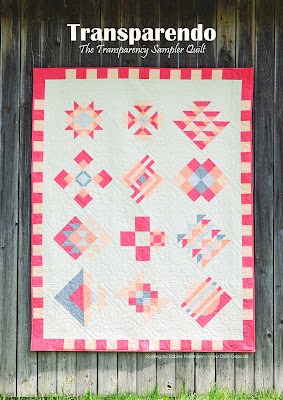
Glad you asked that question. Here it is! This is the sampler featured in the book using the Sunrise colorway with Kona Cotton Solids. All of the fabric names are listed in the book.


Where can you get a copy of the book?

The book is available in my Etsy shop. Click here or on one of the images above to go there. I would be delighted to personally dedicate your book. Just leave your first name when ordering when asked for a dedication.

The book is also available in Germany at einfach bunt Quilts at Verena's online quilt shop. If you live outside of Germany, we are working on digital and print-on-demand editions that will be available in the fall 2023.

If you are a bookstore or patchwork store, feel free to buy wholesale books directly from the publisher. Write to info@easypatchwork.de.

What does the book cost?

The book cost 34,95€ and is protected under the "Buchpreisbindunggesetz." That means, no one is allowed to sell the book in Germany cheaper than the stated price, not even me. This is to protect smaller book and patchwork stores from being undersold by other bookstores. All stores are treated equal.

That is just way too much to pay! I'll sit this one out.

I get you. I really do. A lot of time and effort went into writing this book and that is a lot of money! More than five months went into writing the book. It is professionally printed. It was tested twice by me. The book was published by me which means, I am carrying the entire cost of printing and distributing the book. Let's hope it is a pure success story. 

Additionally, six really amazing talented and professional quilters helped testing and proofing each of the blocks as well as the entire quilt. So, each block has been ceritified including perfect pressing instructions. It really is a true joy to read, look at, and to sew. The instructions are easy and the blocks are fun!

What's in it for you?

And, we have a couple of "treats" lined-up. We, Verena from einfach bunt Quilts, and I will be running a sewalong in the fall. That means, it is probably better to get your book now and start mapping out fabrics and blocks you would like to sew. Check out her online webshop for fabrics listed in the pattern!


How about a sewing day in Germany?

We've got you covered here as well. We have a sewing day planned on October 21, 2023 in Kloster-Roggenburg in Southern Germany! If you are interested, please contact Verena or me (info@easypatchwork.de) with a short email reserving your seat.

We currently have 18 seats available for one fun-filled day starting at 10am until 6pm. 

What awaits you on the sewing day?

Look forward to an awesome day of casual sewing, a full buffet-style lunch, afternoon coffee and cake and unlimted non-alcoholic refreshments. This will be an informal sewing day. If you want help with Transparendo, we will provide our expertise, tips and tricks but will not have an actual course on how to sew each block. It is more important that we are there to help you personally with any questions you may have about quilting and patchwork. The price for all of the fun will be 75€ per individual. An optional shared dinner after the event in the Kloster-Biergarten is not included. 


Seats will fill up soon, so book today. Look forward to seeing you there. 

Thanks for dropping by.

Sunday, June 18, 2023

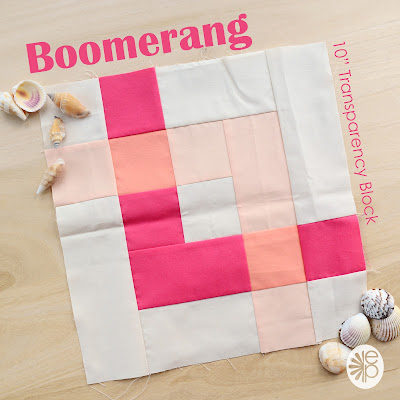
Boomerang - FREE 10" Transparency Quilt Block

Hi there! Thanks for joining me today! Yes, I see that there wasn't but one post written in 2022 and this is the first post in 2023! We are going to have to change that!

I have been very busy the last few months exploring transparency in quilt blocks. When I was doing my research, I couldn't find any quilt samplers just a few blocks. Then I started to explore transparency in several different quilt blocks and decided we needed to change that too.

I don't want to give too much away, but I wanted to share with you a little glimse of what is to come. I have a FREE Quilt block to share with you. Maybe you will get the transparency bug as well.


You will be redirected to my website on the DOWNLOADS tab where you can click on the file. Try the block and please post on Instagram using the hashtags: #boomerangeblock. You might be automatically entered into a really fun and exciting contest. But once again, I don't want to give too much away. 😉

Don't forget to check out the other freebies and downloads as well. Or stop by the pattern shop on Etsy. There are over fifty digital and hardcopy patterns to choose from. You are bound to find something you like with varying skill levels.

Stay tuned for more transparency fun! Check it out on Instagram @easypatchwork.

Tuesday, June 8, 2021

EQ Pearls of Wisdom + Giveaway

Have you hear the news? The Electric Quilt Company is celebrating 30 years of business! It is hard to believe that another five years have gone by. It seems like just yesterday the new EQ8 version came out. What is EQ8 and the Electric Quilt Company? The EQ Company produces the leading quilt design software (EQ8) which I use just about daily in my own designs. It doesn't write the patterns for you, but it takes out all of the math guess work, cutting and dimensions are easily adapted from line drawings in the program. It even prints out templates and foundation papers. I haven't found a limitation yet to the software. It is extremely powerful with a lot of thought put into the programming and needs of quilt designers. If you are computer software savvy, it definitely makes pattern design and writing easier.


As part of the big celebration, the company has teamed up with 30 avid EQ8 users and quilt designers to share in the fun with their own "pearls of wisdom" about the software. Each week another designer will be highlighted with an interview and a giveaway - especially an EQ8 project giveaway! How cool is that? You can download the project, color (re-color or map to color/fabrics) as you wish, print templates/cutting charts and make your very own quilt (in any size)! How cool is that?!

I am very honored and humbled to be a guest participant in the big 30th anniversary celebration! Go check it out on their website to see my favorite pearls as well as other pearls from other designers.

https://doyoueq.com/blog/category/eq-pearls-of-wisdom/

My gift to EQ and to all of their users is a Fancy Color Wheel Quilt - what every quilter needs in their sewing space. 

The Fancy Color Wheel Quilt is based on a painter’s color wheel for you to sew yourself. There are two slightly different designs for you to try, one being a mini quilt (12” center block) and other a midi quilt (20” center block). There is a fancy design with triangles below and a simplified version without triangles. The patterns are made of templates (use up an empty cereal box) and is for an advanced skill level. The pattern uses a total of 51 different fabrics.

Are you familiar with the color wheel?

The color wheel is built with the primary colors forming a triangle in the center (red, yellow and blue). Turn the triangle 60° and you have the secondary colors – adjacent primary colors mixed with each other. Venturing outwards one additional ring, you will find gradients of the primary and secondary colors. The next ring shows triangles in black and white pointing to the shades and tints respectively. Sandwiched in between are the tones (main color with gray added) while the outer most ring uses a range of tints (main color mixed with white) and shades (main color mixed with black). I used the special functions of EQ8 to add tints, shades and tones more commonly known as the color value.

Color is a fascinating and powerful too that influences our perception, emotions and even our consumer behaviours. In the quilting world, we can use color to express a mood, accentuate a piece of a design, or even subdue portions. To achieve this, we must first understand the color wheel, how it is built and how colors interact with each other. 

Color Wheel Made with Solids from Doris K.

A painter's wheel is what quilter's are most drawn to in their designs. It is a mixture of color through paint or a so-called RBY color wheel. Be careful, because there is more than one type of color wheel.

Color Wheel Made with Printed Scraps by Karen Ackva

The color wheel is also divided into warm colors (red, yellow, and orange) which generate life, warmth, engery and positive emotions. Think sunrise and summertime. Cold colors convey security, relaxations, and stability. Think cool water and crisp snow. Individual colors can express their own emotions. 


In no way, shape or form am I an expert on color. Please refer to these publications for more in-depth look at color theory and everything else you would like to know.

Barnes, Christine. COLOR: The Quilter's Guide. Washington, USA: That Patchwork Place Inc. 1997

Wagner, Lauren. Palette Perfect. Barcelona, Spain: Hoaki Boos, S.L., 2018. Color Combinations Inspired by Fashion, Art & Style

As we already know, EQ8 is wonderful for printing templates, foundation patterns, calculating fabric yardage and giving us the correct patches. What it cannot do is write the pattern. If you are looking to create the pattern and prefer written instructions on how to, you can purchase the pattern on Etsy in my easypatchworkSHOP

Patterns includes seven pages DIN A4 page size and includes:

  • Material requirements 
  • Cutting instructions
  • Full-size templates
  • Block construction
  • Patch placement for all fabrics
  • Additional instructions for reverse appliqué of center circle as a second option


Enjoy an extra 30% off today only. No code necessary.

Would you like to make the pattern but are uncertain if you may have all of those pretty rainbow fabrics in your stash or scrap bins? You can always change up the colors and create your own interesting color wheel. Take a look at these ideas below. Recalculate the fabric yardage with the EQ8 Project file for any of the combinations below.

If you just love to sew curves, you can even sew an entire quilt with these XXL 20" blocks.


Thanks for dropping by today to read about the EQ "Pearls of Wisdom" and the Fancy Color Wheel Quilt Project giveway you can find on their website. Let's celebrate their success together. Happy 30th Anniversary, Electric Quilt Company! You rock!

Friday, November 20, 2020

GeoOptics Quilt Pattern

Hi everyone! Thanks for stopping by to check out the new GeoOptics quilt pattern. I am really excited about sharing this quilt with you too. It has been an idea floating around in my head since the beginning of spring this year. I wanted to create a pattern using a simple and traditional block and flip it into something different and unexpected. And if you love mini quilts, there is a mini version just for you. I hope you will enjoy the pattern.


The log cabin block is one of the oldest quilt blocks around. In fact, you might have sewn it as your first ever quilt block. It was one of the first blocks I added to my repetoire and used a quick strip piecing method. We still have that quilt in our household after nearly 20 years!


Well, there is a sister block - the quarter log cabin. She is just one-quarter of the original block. Now, you could sew log cabin blocks together and cut them through the middle twice to get four slivered log cabins, but it is simpler to just sew the block below without slicing. 


This block creates many exciting designs with simple rotations and repetition of blocks. Here are just a few common designs made with the quarter log cabin that you may already know:


I wanted to really maximize the interest of the quarter log cabin by spinning and rotating the blocks. I wanted more elements such as color value and color placement to really shape the design. I sat and tweeked for weeks until my idea evolved into my most favorite design - GeoOptics. See the use of darks, medium and light fabrics to ceate the design. What do you see? There is no wrong or right answer here.

In quilt design and pattern writing, it is very important that others understand what you are saying. So, this time, I wanted to get back in alignment with my own thinking and learning process. I wrote the pattern with little text, more diagrams and more tables. Hopefully you agree that this method is easier to understand especially if English is not your first language. 

I sent out the preliminary patterns to my favorite quilt testers and was amazed to see what they delivered! I am always so stunned to see what others can do with my patterns.

This gorgeous version was created by Ute, who threw in just a hint of color to make it a stunning wall/art quilt. My eye just keeps dancing and dancing around the quilt discovering the different color pops.

Sewn by Ute of Uma.Saar

What truly illuminates this design is the use of color value – light, medium and darks and their placement within the design/blocks. The slow transition in color or value allows a secondary design to emerge. Do you see it? 

But let’s kick it up a notch. What if we bring color into the design?

The original design of lights, mediums and darks is still there, but another design in rainbow transistion flows across the canvas diagonally. Isn’t it beautiful? The added use of rainbow fabrics for a pieced binding with the lightest color in the corner, frames the quilt nicely. This is another added feature to the quilt design. Of course you could just use a one color binding, but I love how the corners sparkle with the yellow color.

If you are looking for a quilting desing, you could go with really fancy custom quilting, but I think a practical allover quilt design also does the trick just as well. Here it is mocked up with an orange peel quilt motif in EQ8 - Electric Quilt Software.

If you have a large stash or want to make up a throw or queen size quilt with your favorite fat quarters, this pattern is perfect for you! Here is another one of the layouts included in the pattern. I will definitely be making this design as well! This pattern will truly become your go-to, patchwork pattern.

Just take a look at our next quilt from one of our pattern testers. I especially love the use of a dark background to bring out the colors. This beautiful quilt was made by Hanna. She chose one of the other four designs found in the pattern booklet. Just look at her sparkling color transition within her blocks!

Sewn by Hanna of hannas_liebe

There are four different size quilts each with the same adjusted block size. You can pick which quilt you prefer – mini, wall or art, throw or queens size. The skill level increases as the blocks and quilt gets smaller. The mini quilt is the hardest.

Hanna had so much fun sewing the pattern, she made the mini version as well. This is one of the other layouts listed in the pattern book. It truly is fun to spin this block around and come up with new designs!

Sewn by Hanna of hannas_liebe

I am currently finishing up the hand quilting on this beauty – the mini quilt version which finishes at 24” x 24”. I think it will make a great oversized pillow.


If all of these quilts are too colorful for you, take a look at Martina’s quilt, she is known for her soft use of soft and sublte shades. It is an amazing scrappy, tone-in-tone, low contrast quilt!

Sewn by Martina  of malu_27117

Are you just not into square quilts? Well, Ulrike had a very interested recipient who was eying her design in process, but wanted a true rectangular bed quilt. No problem – Ulrike and I talked about how she could stay true to the design. She added another row to the top and bottom with a continuation of the design. She also adjusted the borders to make them slightly thinner. The pattern is easily adjustable to whatever suits your needs and preferences.

Sewn by Ulrike of Ulrike_Brauns

May, another of our incredible pattern testers, decided to use the three-fabric design to create this lovely throw sized quilt. It is so stunning with a slight Christmasy touch, don't you think? She quilted it on her  home sewing machine with some awesome matchstick quilting. Check out a glimpse of the super cool striped binding!

Sewn by May of fabraholicquilts

I would like to thank our pattern testers for their awesome work! They all used their own fabric stashes, creativity and know-how to produce their very own one-of-a-kind quilts. Photos courtesy of the creators! They totally hit their designs out of the ballpark! Each one is so lovingly made with an eye to detail. We are so fortunate to have such a great crew!

I had so much fun making samples and testing the pattern myself, I just couldn’t stop. I first made the mini, the the wall, then a super fun scrappy, stash buster accented with Figo - Earth in black.

I had a lot of fun picking out the rainbow gradient fabrics from my stash. I have a lot of fat quarters but most of them are slightly cut into. When choosing shades and gradients, I tried to always have a very luminant color as the middle value and worked lighter and darker from there. It was a fun way to play around with some of the lighter, neglected fabrics in my stash.

During the cutting phase, I realized sometimes, there wasn't enough fabric, so I just picked out something else and rolled with it. It really was so much fun.


I asked the very talented quilter, teacher and shop owner, Sabine Feldmann of Quilt Oase to make a simple allover design, because this will be our new sofa quilt. My husband has already adopted it as his own. It finished at 70” x 70” and is wonderful for snuggling in the autumn months. I just love this allover design!


One day I was thinking about where or how to finish with a photoshooting of the Rainbow (Scrappy) Gradient quilt and wanted to incoroporate my home. I live along the Danube River in Germany, not more than one mile away. In the autumn months, it gets incredibly foggy but oh so much fun to go walking along the river. It's been really foggy around here, so I convinced my husband to go with me on Sunday mornging before our famous Sunday breakfast for a quick photoshoot. Let's give him two thumbs up for a great job!

You might have noticed that the quilt design is upside down. I rather like it that way with this backdrop and the seasonal mood to it. The blues represent the sky, the green the trees and the yellows and reds the fall leaves.


If you like what you see, you can purchase the printed ordigital pattern in my Etsy shop. Starting today and running through Sunday, enjoy 20% off all patterns! 

Would you like to support your local quilt shop? You can also purchase at these stores in Germany:

If your shop doesn't carry easypatchwork patterns, ask them too!

The pattern also shows a quilt on the back cover made only with Kona solids. I am finishing up the binding on it this weekend and can't wait to show you more. This quilt will be kitted and available at Quilt ét Textilkunst. Kits will be available soon. Please ask at your local shop for more information.


Thank you for supporting my quilt pattern and training business. I would like to extent my appreciation with a GIVEAWAY! Leave a comment below stating your favorite color combination or version of the new GeoOptics quilt pattern. One entry per person please.

One lucky person will receive 27 – 5” x 10” cuts of all of the fabrics used in the pattern book to create your very own GeoOptics - Rainbow Gradient Mini. You will also receive two printed copies of the pattern and one Creative Grids 3 ½” x 3 ½” ruler. All products and supplies courtesy of easypatchwork. 

Drawing will be held on Thanksgiving, November 26, 2020. Not associated with anyone other than easypatchwork. Not valid where prohibited. You must be 18 and older participate. Good luck to everyone.

- - - - - - - - -

All photographs were kindly used with permission by the original owner - the one who sewed the quilt. All rights reserved to the originator. 


* * * * * * GIVEAWAY CLOSED * * * * *

Friday, February 7, 2020

modern vs traditional quilt designing

Hi everyone! Thanks for joining us today. I've decided to start blogging (on a regular basis) again. I would like to share my knowledge and experiences for those of you who wish to learn, experiment and better your own quilts. Here is one of my first Quilt Editorials for 2020 - #queditorial.

I would like to share with you my approach to modern vs traditional quilt designing.

As you might already know, I actually design a little bit of both. Although I truly classify myself as a modern-traditionalist, some others see me as a modern quilter. Where's the difference you ask? That's a tough question for me to answer. I don't think I can answer that. I don't really see where the difference in the two.

As defined by the Modern Quilt Guild (MQG),

"Modern quilts are primarily functional and inspired by modern design. Modern quilters work in different styles and define modern quilting in different ways, but several characteristics often appear which may help identify a modern quilt. These include, but are not limited to: the use of bold colors and prints, high contrast and graphic areas of solid color, improvisational piecing, minimalism, expansive negative space, and alternate grid work. "Modern traditionalism" or the updating of classic quilt designs is also often seen in modern quilting." (https://www.themodernquiltguild.com/modern-quilting)

"So how is that different from traditional quilts?" That's my question to myself.

In my humble opinion, traditional quilts are very much functional, use high contrast, are graphic (almost every block uses some type of geometry) and some traditional quilts even use improv piecing (Gee Bend). What seems to be rather different in modern vs. traditional to me is the use of minimalism, negative space and bold colors. 

Let's take a look at those three points in more detail.
  1. The use of minimalism to create artistic designs is a key point in modern quilts. That's just it - art designs. If you approach a quilt design as a piece of art, you might start with an empty canvas. From there, you build up your artwork and layers of fabric. And, although many misinterpret minimalism as art from a five-year-old, a very successful and minimalistic quilt uses a lot of elements the untrained eye does not see, especially the use of quilting to make a second design especially playing on the piecing or original design itself.
  2. With more and more of long arm quilting machines hitting the mainstream market in the late 1990's, the use of negative space, which highlighted the quilting, jumped to the forefront adding to wonderful new styles in quiting. This allowed the use of negative space to take center stage in many modern quilts. Piecing, was once again, pushed to the second row of the quilt designs. Remember, whole cloth quilts in the 1930's? They also had an enormous amount of negative (light) space that was hand quilted.
  3. Bold colors in quilting fabric became readily available in the late 1980'-1990's. This is a moda and cultural trend in society. If you look at different periods throughout history, the fabrics and their luminosity changed over the last century. My mom's quilts used a very soft pastel mauve and blue which were very trending in the 1980's.There were many bright, almost neon prints in my early children's quilts in the late 2000's. At that time, you either found the "traditional" muddied reproduction fabrics or the bright, children's prints. The use of use contrasting, complementary colors or fabrics with varying values (light, medium, dark) will allow a quilt to sparkle. 

I've heard some say the difference between modern and traditional quilt is just the fabric used. Muted small prints personified the bi-centennial quilt revival movement in America (1975-1985) which a lot of people associated with traditional quilting while graphical designs in bold colors represent modern quilting.
So, for me, the difference between modern and traditional quilts is, quite frankly, the purpose. Is it to be seen and appreciated as art or used as a utility quilt? Here is my approach to each one when designing quilt patterns for each classification.

Modern Quilt Designs

When designing a modern quilt, particularly like the one above, I start with an empty canvas. I am free in my designing process. I add elements (usually graphical in nature) to the blank page and move, add, delete, change the elements until a pleasing design emerges.

This design, as well as most of my designs, was designed with Electric Quilt software. The quilt was designed in the custom set layout which allows you the freedom to really build layers of artwork. It allowed my to rotate my strips 45° with easy and place exactly where I wanted to on the canvas.
I am not plugging this software but mentioning it in case you were wondering. Some prefer to use Adobe Illustrator, CAD or even draw their own designs with pencil and graph paper. Use what you feel comfortable with, have access to and can afford. I bought the software at the EQ5 version and loved using it ever since. I would call myself extremely proficient, but there are still so many things to learn with this program. I have not found a limiting factor with designing with it yet. It is not perfect. There are some glitches, but it works well for me.

Then, the practicality and sewability start to jump in the design. Are those real words?? Is it possible to use a precut in this design? How would I sew it together? Is there a simpler way to sew it together? What are those angles? Are they standard angles listed on a quilt ruler? Would the intermediate quilter know how to use her ruler to cut those angles? Is there too much scrap fabric in this design? Which direction should those squares be pressed? Can this design be strip pieced? Those are just a few questions a quilt designer thinks about when desiging his pattern before writing.


Probably the last thing I put into a design is the fabric. What fabrics and color will allow this design to work? Does it only look good with the colors it was designed or can the colors be changed? I prefer to give more choices to the quilter. We all have our own tastes when it come to color choices and palettes.

Also, does the design work with prints as well? Does it work with large and medium scaled prints?


With this particular quilt design, I should have had it long arm quilted to really allow the quilter to accentuate the design. I chose to quilt the quilt myself instead and decided to play with the angles of the strips. I don't see organic quilting in this design, but who am I to say what is right? There are so many fantastic (long- arm and domestic machine) quilters out there who create masterpieces.


The above quilt measures 30" x 40". It was originally designed in 60" x 80" using precuts. It was published in Quiltmaker's Spring 2017 under the name of Pixelated. I had the pleasure of sewing this quilt and quilting it myself. I just love the beautiful photo the magazine made for their publication.


Quiltmaker Jul/Aug 2017 - "Pixelated"

UPDATED: This pattern is still available from Quiltmaker magazine. Click on the photo above.


I even made a smaller 1:2 version measuring 15" x 20". I would love to have an entire mini collection of my own designs.

Traditional Quilt Designs

When designing a traditional quilt, I change my thinking process. I start with a predefined canvas size and layout. Although, it will usually stay a rectangle or square, I think about the size for a usable quilt. What size would that be? It is for a twin, queen, king or a throw quilt? Is this quilt for a baby? Do I want to teach something with the design? Should it be simple? Do I want to show off a fabric line? Can you use precuts? Do you need a large border to fill the design to the requred size? I ask myself more practical question in the beginning. I start with contraints.

Let's look at my sampler quilt. The easypatchwork Advanced Sampler was designed to teach me all different techniques that you should learn about quilting from applique to curved piecing. I wanted to make 12", standard size blocks but also wanted to limit the number to a 3 x 4 grid. That meant I needed to push the design with border strips and sashing. I decided to go extra large on those, because it was supposed to be our bed (queen size) quilt.

I am also not very fond of sampler quilts, because a lot of them are just too unorganized and not uniformed for my taste. I love a balanced design which it hard to achieve with samplers. For sampler quilts, I think reducing the fabric palette to a limited number of 3-4 works best for a more uniformed look. Now, a sampler quilt is very traditional, is it not? Would you consider this a traditional or modern quilt?


This quilt started in 2012 and changed several times throughout the making stages. I hardly ever stay with the same design from start to finish. These were my favorite colors when I started the quilt - yellow, turquoise, and orange. I used white to balance or ground the design. In modern quilts, white, black and gray are considered neutrals and will give the eye a place to rest before moving on throughout a design.


With the use of the very large (fussy cut), prints for the corner blocks (Kate Spain, Fandago), it changes the feel of the quilt. Most traditional quilts would also use small scale prints which really sets off the piecing. Solids do the same thing in "modern" quilts as tone-on-tone or small scale, calico prints do. (The terminology has changed.)

When designing quilts, I like to download the swatches of fabric that I would like to use in the real design to see if the scaling of the fabric will really look like what I imagine. I will tweak the design and make fine adjustments on the mockup. When I actually start making the quilt, there is almost always a design change. Either a different fabric gets cut wrong, or it just doesn't feel right or quite simply, I grab the wrong fabric.


Still, would you classify this quilt as a modern or a traditional quilt? There's folkart appliqué, a Hawaiian block, a Mariner's Compass using templates, y-seams but also foundation paper piecing, straight-stitched applique with bias strips, and curved piecing.


There is a lot of negative space in this quilt as well. Does that mean it is modern? What if we look at the design with an additional border and a dark border in place of the white? Does it look more traditional to you now? If you use a muddy brown in a quilt, does it make it traditional? Likewise, if you use white, does it mean it is modern?


I really don't try to fit in one category or another, but the way I design is different. I consider a traditional quilt a quilt that has a purpose, a utility quilt. That purpose sets a framework of the design. A modern quilt, for me, is one that is designed for art purposes - to hang on the wall. There are virtually no limits and start with a blank canvas when designing.


So what do you think? Did I hit a nerve about modern and traditional quilting? Do you differ in opinion? We would love to hear what you think. Please leave a comment below.

Thank you so much for stopping by.